Crypto 方向

初赛部分

题目1:寻找戒指的旅途

让AI帮我静态分析了一下,发现是PyInstaller 打包的 Python 程序,让他帮我解一下PyInstaller包并反编译出pyc,看到了加密原理:

c(miv)modsc \equiv (m * iv) \mod s

接下来很简单,由output.json里的两组m,iv,c做一个gcd先恢复出模数s,然后根据最后一组的iv,c计算m
exp:

1
2
3
4
5
6
7
8
9
10
11
12
13
14
15
16
17
18
19
20
21
22
23
24
25
26
27
import json
import math
from Crypto.Util.number import long_to_bytes

with open("output.json", "r", encoding="utf-8") as f:
obj = json.load(f)

# 通过已知样本恢复模数 s
t = []
for row in obj["data"]:
m = row["m"]
iv = row["iv"]
c = row["c"]
t.append(m * iv - c)

s = math.gcd(*t)
print("[+] s =", s)

# 解密目标密文
target = obj["C"][0]
iv = target["iv"]
c = target["c"]

m = c * pow(iv, -1, s) % s
flag = long_to_bytes(m)

print("[+] flag =", flag.decode())

flag:flag{I_got_the_Real_R1ng_I_Am_The_LOrd_0F_the_R1ng5_in_SparkCTF}

题目2:lattice 1

翻译一下题目给出的式子:

ca0m02+a1m1+a2(modp)c \equiv a_0 \cdot m_0^2 + a_1 \cdot m_1 + a_2 \pmod p

其中,a0,a1,a2a_0,a_1,a_2都是512位的,m0是flag的uuid转成大整数之后,大约336位,m1是100位
结合题目描述和位数的信息,要求的未知的都比较小,所以可以想到构造格子打copper
我们用x,y表示m0和m1,得到:

a0x2+a1y+(a2c)0(modp)a_0 x^2 + a_1 y + (a_2 - c) \equiv 0 \pmod p

为了成功打copper,得变成首一多项式,同乘a0模p的逆元,得到:

x2+a1a0y+a2ca00(modp)x^2 + \frac{a_1}{a_0} y + \frac{a_2 - c}{a_0} \equiv 0 \pmod p

k1a1a01(modp)k_1 \equiv a_1 \cdot a_0^{-1} \pmod pk0(a2c)a01(modp)k_0 \equiv (a_2 - c) \cdot a_0^{-1} \pmod p,得到最终的二元多项式:

f(x,y)=x2+k1y+k00(modp)f(x, y) = x^2 + k_1 y + k_0 \equiv 0 \pmod p

接下来的攻击目标是:将模p的方程转化为整数方程。也就是说要找到一个多项式h(x,y),满足两个条件:
1.和原方程有同样的根(x0,y0)
2.带入根之后,多项式的计算结果的绝对值小于p
这样就可以去掉模p的影响,之后计算结式就能求出整数解
那么如何用LLL算法找到这样的多项式呢?

第一步,构造多项式族
构造一系列多项式,它们都共享同样的根 (x0,y0)(x_0, y_0)pmp^m
通常形式如下:

gi,j,k(x,y)=xiyjf(x,y)kpmkg_{i,j,k}(x, y) = x^i \cdot y^j \cdot f(x, y)^k \cdot p^{m-k}

这些多项式的组合构成了我们的解空间。
第二步,构造格基矩阵
将这些多项式的系数提取出来,构建一个巨大的矩阵。矩阵的每一行代表一个多项式。
第三步,LLL 算法
作用是在这个格空间中寻找“最短向量”。在代数意义上,向量的“长度”对应多项式系数的大小。LLL 找到的最短向量,对应着一个系数极小的多项式 h(x,y)h(x, y)
第四步,Howgrave-Graham定理
该定理保证了:只要未知数 x,yx, y 的范围足够小,且 LLL 找到的多项式系数足够小,那么就一定满足 h(x0,y0)<pm|h(x_0, y_0)| < p^m

在本题中,我们已知flag格式是flag{},可以对未知数部分进行优化:

m0=prefix2296+x28+suffixm_0 = \text{prefix} \cdot 2^{296} + x \cdot 2^8 + \text{suffix}

其中,prefix=flag{\text{prefix} = \text{flag\{}suffix=}\text{suffix} = \text{\}},现在UUID部分的大小被限制在 X<2288X < 2^{288},而 yy 的界限是 Y<2100Y < 2^{100}
在真正打脚本的时候遇到了几个问题:
1.构造格子的办法和参数选择经常出现矛盾,例如参数太大计算量大就容易卡死,但是减小参数就导致界限不足跑不出来。因此一定要根据一切可利用的信息来减小未知量,优化格子
2.sagemath内置的small_roots函数只支持单变量,因此需要我们手动构造格子,不能用自带的函数
3.多项式内的系数必须在同一个环上
最后的脚本是:

1
2
3
4
5
6
7
8
9
10
11
12
13
14
15
16
17
18
19
20
21
22
23
24
25
26
27
28
29
30
31
32
33
34
35
36
37
38
39
40
41
42
43
44
45
46
47
48
49
50
51
52
53
54
55
56
57
58
59
60
61
62
63
64
65
66
67
68
69
70
71
72
73
74
75
76
77
78
79
80
81
82
83
84
85
86
87
88
89
90
91
92
93
94
95
96
97
98
99
100
101
102
103
104
105
106
107
108
109
110
111
112
113
114
115
116
117
118
119
120
121
122
123
124
125
126
127
128
129
130
131
132
133
134
135
136
137
138
139
140
141
142
143
144
145
146
147
148
149
150
151
152
153
154
155
156
157
158
159
160
161
162
163
164
165
166
167
168
169
170
171
172
173
174
175
176
177
178
179
180
181
182
183
184
185
from Crypto.Util.number import long_to_bytes,bytes_to_long
import itertools
import time


# --- 核心攻击算法 (Defund/Coron 风格) ---
def small_roots(f, bounds, m=1, d=None):
if not d: d = f.degree()

# 切换到整数环
f = f.change_ring(ZZ)
R = f.base_ring()
vars = f.variables()
N = R.cardinality() # 对于模p多项式,这里其实不起作用,我们手动处理

# 获取正确的模数 (题目中是 p)
# 注意:传入的 f 是 Zmod(p) 上的,change_ring(ZZ) 后丢失了模数信息
# 我们需要在构造格子时手动乘 p

print(f"[*] 初始化 Lattice (m={m}, d={d})...")

# 生成移位多项式 (Shift Polynomials)
# 核心公式: g_{i,j,k} = x^i * y^j * f^k * p^(m-k)
shifts = []
# 我们需要显式传递模数 p,因为 f 在 ZZ 上没有模数
# 从外部传入 p 会更方便,但这里我们可以从原始环推断
# 为了通用性,我们在外部构造好 shift 可能会更清晰,但为了封装:
# 假设 f 的原始环是 Zmod(p)

# 重新获取 p
# 这里通过一个小技巧获取 p:
# 如果 f 是 ZZ 多项式,我们假设外部逻辑保证了同余关系
# 但标准的 coppersmith 需要 p。
# 我们让函数接受 modulus 参数,或者简化逻辑:
# 直接在主流程里写 Lattice 构造 (如下所示)。
return []

# 为了确保无误,我们直接在主脚本中实现特定的 Lattice 构造逻辑
# 这样可以避免任何环境或传参导致的错误。

def solve_problem():
# 1. 题目数据
a_list = [7741319537308958501673945651303135989370388830734734613244416411870009515202597589426755861700658282411334090461856172066647825919965025780441733193707631, 12708340876096551823276094712154414605837041085217978402889133607179618520600229244521374546834126064757709025940472587603468976924003081466800964792013013, 9030711413715281616029109754098399408890501652813598936414313002302683150175563423273614447665545285792056876395737350904586524679558542610755539162370587]
p = 94690982578140825601653787176952155164024939144212543950179743880762139204220427235536177869621577569149451317757150677696875463702458773015732097441809269178006694893934645510620728280094314782174427788383842690678353897827910292552841901283381647961750223031946826141032247802658949788038880100911120792699
c = 60290713494234755291199980313218149618616938762129052976161786328128580668563788306218103869210206471067575629316788623403982658483270173487078950519913786502247521966103352915555189439284683709867886369283376517212062313536340599285181669868490307467284768160302733028625254340933632547167284245344104667790

# 2. 环与多项式定义
PR.<x, y> = PolynomialRing(Zmod(p))
a0, a1, a2 = a_list
inv_a0 = inverse_mod(a0, p)

# 3. 构造 m0 的已知结构
# flag = "flag{" + UUID + "}"
# 总长 42 字节。
# 前缀: "flag{" (5字节)
# 后缀: "}" (1字节)
# 未知部分 x: UUID (36字节) -> 288 bits

prefix = b"flag{"
suffix = b"}"

prefix_val = bytes_to_long(prefix)
suffix_val = bytes_to_long(suffix)

# m0 = (prefix << 296) + (x << 8) + suffix
# 解释:
# suffix 占 8 bits (0-7)
# x 占 288 bits (8-295)
# prefix 占 40 bits (296-335)
m0_known = (prefix_val << 296) + suffix_val

# 代入方程: a0 * m0^2 + a1 * m1 + a2 = c
# 变为: (m0_known + x*2^8)^2 + (a1/a0)*y + (a2-c)/a0 = 0
k1 = (inv_a0 * a1) % p
k0 = (inv_a0 * (a2 - c)) % p

# f(x, y)
f = (m0_known + x * 2**8)**2 + k1 * y + k0

# 4. 参数设置
# X_bound: 2^288 (36字节)
# Y_bound: 2^100
X_bound = 2**288
Y_bound = 2**100
bounds = {x: X_bound, y: Y_bound}

# m=3, d=4 是一个比较稳健的组合
m = 3
d = 4

print(f"[*] Bounds: X=2^{log(X_bound, 2):.1f}, Y=2^{log(Y_bound, 2):.1f}")

# 5. 构造 Lattice
f_zz = f.change_ring(ZZ)
vars_zz = f_zz.parent().gens() # x, y in ZZ
x_z, y_z = vars_zz

shifts = []
# 只有当 i+j 总体次数不高时才加入,保持 Lattice 稀疏度
for k in range(m + 1):
for i in range(d - k + 1):
for j in range(d - k + 1):
# 剪枝: 保持总次数限制 (可选,但推荐)
if i + j + k * f.degree() <= max(d, m*f.degree()):
# 构造 shift: x^i * y^j * f^k * p^(m-k)
shift = (x_z**i) * (y_z**j) * (f_zz**k) * (p**(m-k))
shifts.append(shift)

# 提取单项式并排序
monomials = set()
for s in shifts:
monomials.update(s.monomials())
monomials = sorted(list(monomials))

print(f"[*] 格子维度: {len(shifts)} x {len(monomials)}")

# 填充矩阵
L = Matrix(ZZ, len(shifts), len(monomials))
for r, poly in enumerate(shifts):
for c, mono in enumerate(monomials):
# 系数 * 变量Scale
coeff = poly.monomial_coefficient(mono)
scale = 1
if mono.degree(x_z) > 0: scale *= X_bound ** mono.degree(x_z)
if mono.degree(y_z) > 0: scale *= Y_bound ** mono.degree(y_z)
L[r, c] = coeff * scale

# 6. LLL
print("[*] 正在执行 LLL...")
B = L.LLL()
print("[*] LLL 完成。")

# 7. 提取短多项式并求解
# 我们收集所有满足该界限的向量,不仅仅是第一个
pols = []
for i in range(B.nrows()):
vec = B[i]
poly = 0
for j, mono in enumerate(monomials):
scale = 1
if mono.degree(x_z) > 0: scale *= X_bound ** mono.degree(x_z)
if mono.degree(y_z) > 0: scale *= Y_bound ** mono.degree(y_z)
poly += (vec[j] // scale) * mono

if poly.is_constant(): continue

# 检查是否为0多项式(有些实现会产生0行)
if poly == 0: continue
pols.append(poly)

print(f"[*] 找到 {len(pols)} 个候选多项式。")

# 使用 Groebner Basis / Variety 求解
# 这是比 resultant 更稳健的方法
if pols:
print("[*] 正在计算 Variety (求根)...")
# 我们可以只取前几个最短的,通常 2-3 个就够了
ideal_polys = pols[:min(len(pols), 3)]
I = Sequence(ideal_polys, f_zz.parent().change_ring(QQ)).ideal()

try:
# variety(ring=ZZ) 会自动寻找整数解
roots = I.variety(ring=ZZ)
for r in roots:
# r 是字典 {x: val, y: val}
val_x = int(r[x_z])
print(f"[+] 发现根 x: {val_x}")

# 恢复 m0
m0_rec = m0_known + (val_x << 8)
flag_bytes = long_to_bytes(m0_rec)
print(f"[+] 解码结果: {flag_bytes}")

if b"flag{" in flag_bytes:
print("\nSUCCESS!!!")
return
except Exception as e:
print(f"[-] Variety求解出错: {e}")
# 备选:如果 variety 失败,尝试暴力验证 LLL 结果中最短向量的根
# 对于本题,y 很小,也可以尝试对最短多项式进行 y 的穷举(如果它不含 x)
pass

print("[-] 未能找到 Flag,请尝试微调 m 或 d。")

solve_problem()

运行结果:[] Bounds: X=2^288.0, Y=2^100.0
[
] 格子维度: 42 x 25
[] 正在执行 LLL…
[
] LLL 完成。
[] 找到 25 个候选多项式。
[
] 正在计算 Variety (求根)…
[+] 发现根 x: 103714300444054387887339203139930231726487903284461116240497528576823017989460585571429
[+] 解码结果: b’flag{5c5d5d52-1a7e-4233-aba7-1655070d2cde}’

题目3:lattice 2

题目意思很简单明了,但是搜索深度是2^101,太大了,不能直接爆破,一开始不知道该怎么和格联系上,后来刷博客刷到了类似的题型和解法
大概意思是将flag用ASCII和数学式子表达出来,然后转化为子集和问题
已知 g 的 ASCII 码是 103,o 的 ASCII 码是 111,两者相差 8。设 xi{0,1}x_i \in \{0, 1\} 表示第 ii 个字符是否为 o(其中 0i1000 \le i \le 100)。
此时整个 flag 对应的整数 FF 可以表示为:

F=B+i=0100xi8256101iF = B + \sum_{i=0}^{100} x_i \cdot 8 \cdot 256^{101-i}

其中,BB 是假设 101 位字符全为 g 时的基础数值。
根据题目给出的加密逻辑 Fc(modp)F \equiv c \pmod p,代入上面的公式可得:

i=0100xi(8256101i)cB(modp)\sum_{i=0}^{100} x_i \cdot \left(8 \cdot 256^{101-i}\right) \equiv c - B \pmod p

令系数 Ai=(8256101i)(modp)A_i = (8 \cdot 256^{101-i}) \pmod p,目标值 T=(cB)(modp)T = (c - B) \pmod p
问题即可转化为标准的子集和问题,即寻找一组 xi{0,1}x_i \in \{0, 1\} 和一个整数 kk,使得:

i=0100xiAikp=T\sum_{i=0}^{100} x_i A_i - k \cdot p = T

然后可以构造格基规约矩阵。
为了让 LLL 算法更容易命中短向量,构造一个 (N+2)×(N+2)(N+2) \times (N+2) 的格矩阵 MM(此处 N=101N = 101),将变量转化为 {1,1}\{-1, 1\} 的形式。
构建的格矩阵 MM 如下:

M=(2000A0W0200A1W0020A100W0000pW1111TW)M = \begin{pmatrix} 2 & 0 & \dots & 0 & 0 & A_0 \cdot W \\ 0 & 2 & \dots & 0 & 0 & A_1 \cdot W \\ \vdots & \vdots & \ddots & \vdots & \vdots & \vdots \\ 0 & 0 & \dots & 2 & 0 & A_{100} \cdot W \\ 0 & 0 & \dots & 0 & 0 & p \cdot W \\ -1 & -1 & \dots & -1 & 1 & -T \cdot W \\ \end{pmatrix}

矩阵原理解析:矩阵左上角 101×101101 \times 101 的对角线元素为 22,最后一行前 101 列对应全为 1-1
在格规约过程中,如果对应系数为 xix_i,前 101 列的计算结果将是 2xi12x_i - 1。因为 xi{0,1}x_i \in \{0, 1\},所以这部分结果必定为 ±1\pm 1,这极大地缩短了目标向量的长度。
N+1N+1 列(倒数第二列)是用于固定常数 11 的权重列。第 N+2N+2 列(最后一列)是等式校验列。我们引入一个极大的权重常数 WW(例如 210242^{1024}),强制 LLL 算法在寻找最短向量时,必须让这一列的线性组合结果精确为 00
exp:

1
2
3
4
5
6
7
8
9
10
11
12
13
14
15
16
17
18
19
20
21
22
23
24
25
26
27
28
29
30
31
32
33
34
35
36
37
38
39
40
41
42
43
44
45
46
47
48
49
50
51
52
53
54
55
56
57
58
59
60
61
62
63
64
65
# 已知参数
p = 2157911408903816440001478305817039407175476474018384087827264804670444904936946922895956667319579115769204739052099777659
c = 1174991717228130578398439743141866600386053936270000296953662636741858928760200802613536886618630745247582903538089645287

# 计算基础偏置
base_flag = b"flag{" + b"g"*101 + b"}"
base_val = int.from_bytes(base_flag, 'big')

# 计算目标值 T
T = (c - base_val) % p

N = 101
A = []
for i in range(N):
# 位权计算:每个字符的增量为 8 ('o' - 'g' = 8)
weight = (8 * pow(256, 101 - i, p)) % p
A.append(weight)

# 构造 (N+2) * (N+2) 维度的格矩阵
dim = N + 2
M = Matrix(ZZ, dim, dim)

W = 2^1024 # 给等式列设置极大的权重
W2 = 1 # 常数1列的权重

# 填充矩阵
for i in range(N):
M[i, i] = 2
M[i, dim - 1] = A[i] * W

M[N, dim - 1] = p * W

for i in range(N):
M[N+1, i] = -1

M[N+1, N] = W2
M[N+1, dim - 1] = -T * W

print("开始运行 LLL 算法...")
M_red = M.LLL()
print("LLL 规约完成,正在提取 flag...")

# 在规约后的格基中寻找符合条件的最短向量
for row in M_red:
# 最后一列必须为0,且常数列必须为 1 或 -1
if row[dim-1] == 0 and abs(row[N]) == W2:
ans = ""
valid = True

# 为了处理可能的符号反转,根据 row[N] 决定正负
sign = 1 if row[N] == W2 else -1

for i in range(N):
val = row[i] * sign
if val == 1: # 2*1 - 1 = 1 => 选 'o'
ans += "o"
elif val == -1: # 2*0 - 1 = -1 => 选 'g'
ans += "g"
else:
valid = False
break

if valid:
print(f"\n找到 Flag: flag{{{ans}}}")
break

flag:flag{ogggoogoooggggggoooogoggogoogoggogoogogoggoogooogggogggggggooogogogogggogogggogggggggggggggogogooggog}

题目4:随机数之旅

题目意思很明确,key是通过random调用的16字节,我们需要从给出的hint来恢复这个random状态
经典的破解MT19937 PRNG伪随机数问题
学习一下师傅们的经典文章:https://xenny.wiki/posts/crypto/PRNG/MT19937.html
本题中,hint给出了同一个状态后续2506x8=20048位的泄露,但是每次都是泄露的32位中的高8位,不是完整输出,不能直接untemper,所以得写成在GF(2)域上的线性方程组
然后把624x32个状态bit当未知数,把hint的20048个bit变成20048个方程组去做高斯消元
但是这里会有一个问题,CPython中,twist是in-place更新,就会导致原始状态state[0]的低31位不会线性传播到可见的hint中,我们写脚本去恢复初始state也会发现仍然剩下了31位的自由度,这31位是“藏”在了key调用的第一个32bit里,后面需要爆破一下2^31中可能性,不过可以加上已知flag头的flag{做一下DFS

第一阶段:

1
2
3
4
5
6
7
8
9
10
11
12
13
14
15
16
17
18
19
20
21
22
23
24
25
26
27
28
29
30
31
32
33
34
35
36
37
38
39
40
41
42
43
44
45
46
47
48
49
50
51
52
53
54
55
56
57
58
59
60
61
62
63
64
65
66
67
68
69
70
71
72
73
74
75
76
77
78
79
80
81
82
83
84
85
86
87
88
89
90
91
92
93
94
95
96
97
98
99
100
101
102
103
104
105
106
107
108
109
110
111
112
113
114
115
116
117
118
119
120
121
122
123
124
125
126
127
128
129
130
131
132
133
134
135
136
137
138
139
140
141
142
143
144
145
146
147
148
149
150
151
152
153
154
155
156
157
158
159
160
161
162
163
164
165
166
167
168
169
170
171
172
173
174
175
176
177
178
179
180
181
182
183
184
185
186
187
188
189
190
191
192
193
194
195
196
197
198
199
200
201
202
203
204
205
206
207
208
209
210
211
212
213
214
215
216
217
218
219
220
221
#!/usr/bin/env python3
# -*- coding: utf-8 -*-

import ast
import sys
import random

N = 624
M = 397

UPPER_MASK = 0x80000000
LOWER_MASK = 0x7fffffff
MATRIX_A = 0x9908b0df

B = 0x9d2c5680
C = 0xefc60000

SKIP_OUTPUTS = 4 # randbytes(16) 先消耗 4 个 32-bit 输出


def xor_word(a, b):
return [x ^ y for x, y in zip(a, b)]


def shift_right(a, k):
r = [0] * 32
for i in range(32 - k):
r[i] = a[i + k]
return r


def shift_left(a, k):
r = [0] * 32
for i in range(k, 32):
r[i] = a[i - k]
return r


def and_mask(a, mask):
r = [0] * 32
for i in range(32):
if (mask >> i) & 1:
r[i] = a[i]
return r


def const_mul(bitcoeff, const):
r = [0] * 32
for i in range(32):
if (const >> i) & 1:
r[i] = bitcoeff
return r


def or_disjoint(u, l):
return [x ^ y for x, y in zip(u, l)]


def temper_bits(x):
y = x
y = xor_word(y, shift_right(y, 11))
y = xor_word(y, and_mask(shift_left(y, 7), B))
y = xor_word(y, and_mask(shift_left(y, 15), C))
y = xor_word(y, shift_right(y, 18))
return y


def twist_sym_inplace(mt):
mt = mt[:]

for kk in range(N - M):
y = or_disjoint(
and_mask(mt[kk], UPPER_MASK),
and_mask(mt[kk + 1], LOWER_MASK),
)
mt[kk] = xor_word(
xor_word(mt[kk + M], shift_right(y, 1)),
const_mul(y[0], MATRIX_A),
)

for kk in range(N - M, N - 1):
y = or_disjoint(
and_mask(mt[kk], UPPER_MASK),
and_mask(mt[kk + 1], LOWER_MASK),
)
mt[kk] = xor_word(
xor_word(mt[kk + (M - N)], shift_right(y, 1)),
const_mul(y[0], MATRIX_A),
)

y = or_disjoint(
and_mask(mt[N - 1], UPPER_MASK),
and_mask(mt[0], LOWER_MASK),
)
mt[N - 1] = xor_word(
xor_word(mt[M - 1], shift_right(y, 1)),
const_mul(y[0], MATRIX_A),
)

return mt


def add_row_to_basis(row, basis):
while row:
p = row.bit_length() - 1
if p == 0:
return (row & 1) == 0
if p in basis:
row ^= basis[p]
else:
basis[p] = row
return True
return True


def build_basis(hint_bytes, start_idx=SKIP_OUTPUTS):
# bit0 存 RHS;bit1.. 对应变量
mt = [[(1 << (1 + i * 32 + b)) for b in range(32)] for i in range(N)]
idx = start_idx
basis = {}

for byte in hint_bytes:
if idx >= N:
mt = twist_sym_inplace(mt)
idx = 0

y = temper_bits(mt[idx])
idx += 1

# getrandbits(8) 对应 tempered 输出的高 8 位
for bpos in range(8):
rhs = (byte >> bpos) & 1
row = rhs ^ y[24 + bpos]
if not add_row_to_basis(row, basis):
raise RuntimeError("UNSAT: 线性系统不一致")

return basis


def solve_from_basis(basis, nvars):
pivots = sorted(basis.keys())
pivot_vars = set(p - 1 for p in pivots)
free_vars = [i for i in range(nvars) if i not in pivot_vars]

sol = 0
for p in pivots:
row = basis[p]
var = p - 1
rhs = row & 1
row_vars = (row >> 1) & ~(1 << var)
parity = (sol & row_vars).bit_count() & 1
if rhs ^ parity:
sol |= 1 << var

return sol, free_vars


def state_from_solution(sol_bits):
mt = []
for i in range(N):
w = 0
base = i * 32
for b in range(32):
if (sol_bits >> (base + b)) & 1:
w |= 1 << b
mt.append(w & 0xFFFFFFFF)
return mt


def main():
path = sys.argv[1] if len(sys.argv) > 1 else "data.txt"

with open(path, "r", encoding="utf-8") as f:
lines = [ln.strip() for ln in f if ln.strip()]

if len(lines) < 2:
print("data.txt 需要两行:第一行 cipher,第二行 hint")
sys.exit(1)

cipher = bytes(ast.literal_eval(lines[0]))
hint = bytes(ast.literal_eval(lines[1]))

basis = build_basis(hint, SKIP_OUTPUTS)
sol, free_vars = solve_from_basis(basis, N * 32)
mt = state_from_solution(sol)

x0_msb = (mt[0] >> 31) & 1

# 关键:把恢复出的状态直接塞回 CPython random
r = random.Random()
r.setstate((3, tuple(mt) + (0,), None))

key = r.randbytes(16)
suffix = key[4:]

# 回放验证
replay = bytes(r.getrandbits(8) for _ in range(len(hint)))
ok = (replay == hint)

with open("params.h", "w", encoding="utf-8") as f:
f.write("#pragma once\n")
f.write(f"#define X0_MSB {x0_msb}\n")
f.write("static const unsigned char KEY_SUFFIX[12] = {")
f.write(",".join(f"0x{b:02x}" for b in suffix))
f.write("};\n")
f.write(f"static const unsigned char CIPHER[{len(cipher)}] = {{")
f.write(",".join(f"0x{b:02x}" for b in cipher))
f.write("};\n")
f.write(f"#define CIPHER_LEN {len(cipher)}\n")

print(f"[+] rank={len(basis)} free={len(free_vars)} x0_msb={x0_msb} suffix={suffix.hex()}")
print(f"[+] replay ok = {ok}")
print("[+] wrote params.h")

if not ok:
print("[!] replay mismatch,说明 stage1 仍然不对")
sys.exit(1)


if __name__ == "__main__":
main()

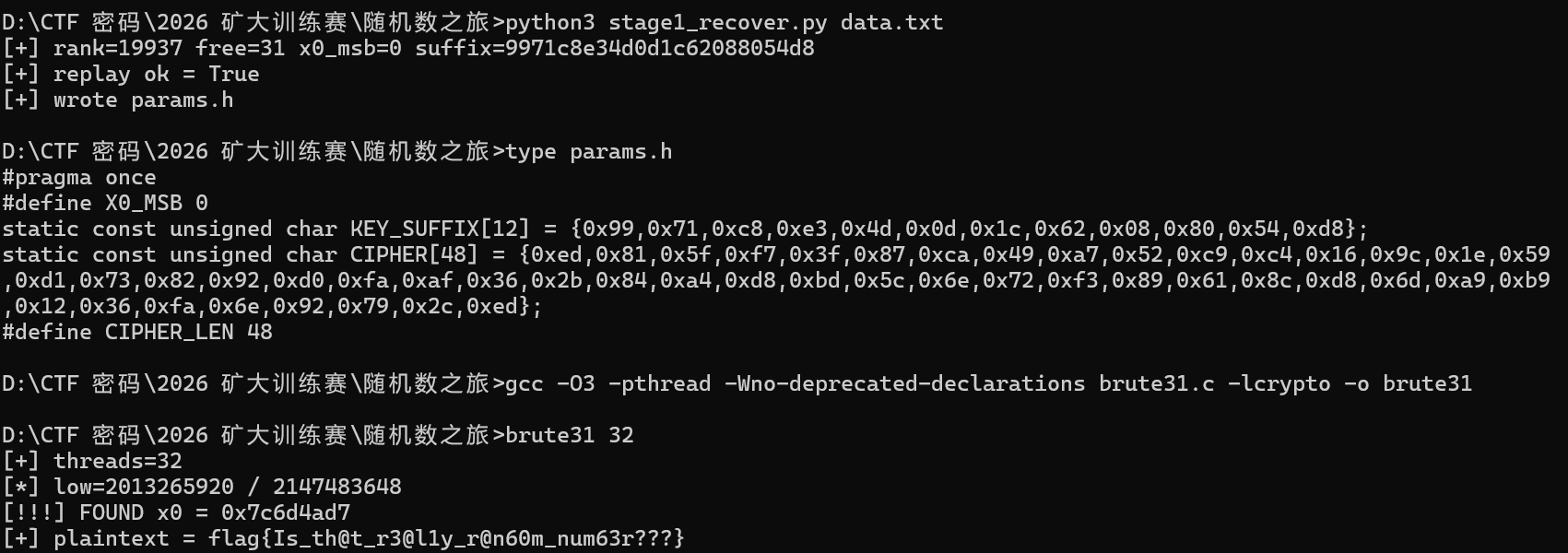
能得到一个params.h文件,然后再让AI写一个C程序去爆破(速度比python快一点)

1
2
3
4
5
6
7
8
9
10
11
12
13
14
15
16
17
18
19
20
21
22
23
24
25
26
27
28
29
30
31
32
33
34
35
36
37
38
39
40
41
42
43
44
45
46
47
48
49
50
51
52
53
54
55
56
57
58
59
60
61
62
63
64
65
66
67
68
69
70
71
72
73
74
75
76
77
78
79
80
81
82
83
84
85
86
87
88
89
90
91
92
93
94
95
96
97
98
99
100
101
102
103
104
105
106
107
108
109
110
111
112
113
114
115
116
117
118
119
120
121
122
123
124
125
126
127
128
129
130
131
132
133
134
135
136
137
138
139
140
141
142
143
144
145
146
147
148
149
150
151
152
153
154
155
156
#include <stdio.h>
#include <stdint.h>
#include <string.h>
#include <stdlib.h>
#include <pthread.h>
#include <openssl/aes.h>

#include "params.h"

static volatile int FOUND = 0;
static uint32_t FOUND_X0 = 0;
static unsigned char FOUND_PT[CIPHER_LEN];

static inline uint32_t temper(uint32_t x) {
uint32_t y = x;
y ^= (y >> 11);
y ^= (y << 7) & 0x9d2c5680u;
y ^= (y << 15) & 0xefc60000u;
y ^= (y >> 18);
return y;
}

static inline int is_printable(unsigned char c) {
return (c >= 0x20 && c <= 0x7e) || c == '\n' || c == '\r' || c == '\t';
}

typedef struct {
int tid;
int nthreads;
} arg_t;

static void *worker(void *vp) {
arg_t *a = (arg_t *)vp;
int tid = a->tid;
int nthreads = a->nthreads;

unsigned char key[16];
memcpy(key + 4, KEY_SUFFIX, 12);

AES_KEY dk;
unsigned char block0[16];
unsigned char pt[CIPHER_LEN];

const uint64_t LIMIT = (1ULL << 31);

for (uint64_t low = (uint64_t)tid; low < LIMIT && !FOUND; low += (uint64_t)nthreads) {
uint32_t x0 = ((uint32_t)X0_MSB << 31) | (uint32_t)low;
uint32_t y0 = temper(x0);

key[0] = (unsigned char)(y0 & 0xff);
key[1] = (unsigned char)((y0 >> 8) & 0xff);
key[2] = (unsigned char)((y0 >> 16) & 0xff);
key[3] = (unsigned char)((y0 >> 24) & 0xff);

AES_set_decrypt_key(key, 128, &dk);
AES_decrypt(CIPHER, block0, &dk);

if (block0[0] != 'f' || block0[1] != 'l' || block0[2] != 'a' || block0[3] != 'g' || block0[4] != '{') {
goto progress;
}

for (int i = 0; i < 16; i++) {
if (!is_printable(block0[i])) {
goto progress;
}
}

for (int off = 0; off < CIPHER_LEN; off += 16) {
AES_decrypt(CIPHER + off, pt + off, &dk);
}

int has_brace = 0;
for (int i = 0; i < CIPHER_LEN; i++) {
if (pt[i] == '}') {
has_brace = 1;
break;
}
}
if (!has_brace) {
goto progress;
}

unsigned char pad = pt[CIPHER_LEN - 1];
if (pad < 1 || pad > 16) {
goto progress;
}
for (int i = 0; i < pad; i++) {
if (pt[CIPHER_LEN - 1 - i] != pad) {
goto progress;
}
}

FOUND = 1;
FOUND_X0 = x0;
memcpy(FOUND_PT, pt, CIPHER_LEN);
break;

progress:
if (tid == 0 && (low % (1ULL << 26) == 0)) {
fprintf(stderr, "\r[*] low=%llu / %llu",
(unsigned long long)low,
(unsigned long long)LIMIT);
fflush(stderr);
}
}

return NULL;
}

int main(int argc, char **argv) {
int nthreads = 8;
if (argc > 1) {
nthreads = atoi(argv[1]);
}
if (nthreads <= 0) {
nthreads = 1;
}

printf("[+] threads=%d\n", nthreads);

pthread_t *th = (pthread_t *)calloc((size_t)nthreads, sizeof(pthread_t));
arg_t *args = (arg_t *)calloc((size_t)nthreads, sizeof(arg_t));
if (!th || !args) {
fprintf(stderr, "[!] calloc failed\n");
return 1;
}

for (int i = 0; i < nthreads; i++) {
args[i].tid = i;
args[i].nthreads = nthreads;
pthread_create(&th[i], NULL, worker, &args[i]);
}

for (int i = 0; i < nthreads; i++) {
pthread_join(th[i], NULL);
}

if (!FOUND) {
printf("\n[!] not found\n");
free(th);
free(args);
return 1;
}

unsigned char pad = FOUND_PT[CIPHER_LEN - 1];
int msg_len = (int)CIPHER_LEN - (int)pad;

printf("\n[!!!] FOUND x0 = 0x%08x\n", FOUND_X0);
printf("[+] plaintext = ");
fwrite(FOUND_PT, 1, msg_len, stdout);
putchar('\n');

free(th);
free(args);
return 0;
}

在cmd里运行的结果是:

题目5:RSA? O! RCA!

这题是CVE-2017-15361,ROCA漏洞,网上有很多现成的分析和脚本,也出过很多类似的题目
主要参考:https://bitsdeep.com/posts/analysis-of-the-roca-vulnerability/
exp:

1
2
3
4
5
6
7
8
9
10
11
12
13
14
15
16
17
18
19
20
21
22
23
24
25
26
27
28
29
30
31
32
33
34
35
36
37
38
39
40
41
42
43
44
45
46
47
48
49
50
51
52
53
54
55
56
57
58
59
60
61
62
63
64
65
66
67
68
69
70
71
72
73
74
75
76
77
78
79
80
81
82
83
84
85
86
87
88
89
90
91
92
93
94
95
96
97
98
99
100
101
102
103
104
105
106
107
108
109
110
111
112
113
114
115
116
117
118
119
120
121
122
123
124
125
126
127
128
129
130
131
132
133
134
135
136
137
138
139
140
141
142
143
144
145
146
147
148
149
150
151
152
153
154
155
156
157
158
159
160
161
162
163
164
165
166
167
168
169
170
171
172
173
174
175
176
177
178
179
180
181
182
#!/usr/bin/env sage
# -*- coding: utf-8 -*-

from sage.all import *
import sys

# =======================
# Instance from rsa_o!rca!.py
# =======================
N = Integer(17853573899076341181096267567874616214556285809566419320975211748455658403574952424384450961122059841394637349769390646220566170958316752370568080811)
ENC = Integer(14134528243637339528516880595615017358007046031917320457849840313575913728415212293709028402353118219198627787035921516021202481286846551245272653155)
E = Integer(65537)

# =======================
# M' : a special divisor of primorial(39) used in ROCA-512 setting
# (This M' is exactly product of many primes <= 167 whose 65537-order divides 1201200)
# =======================
M_PRIME = Integer(0x1b3e6c9433a7735fa5fc479ffe4027e13bea) # = 2373273553037774377596381010280540868262890
MM = 5
TT = MM + 1

# =======================
# Howgrave-Graham Coppersmith (univariate, self-contained)
# =======================
def coppersmith_howgrave_univariate(pol, modulus, beta, mm, tt, XX):
dd = pol.degree()
nn = dd * mm + tt

if not (0 < beta <= 1):
raise ValueError("beta must be in (0,1].")
if not pol.is_monic():
raise ArithmeticError("Polynomial must be monic.")

polZ = pol.change_ring(ZZ)
x = polZ.parent().gen()

gg = []
for ii in range(mm):
for jj in range(dd):
gg.append((x * XX) ** jj * modulus ** (mm - ii) * polZ(x * XX) ** ii)
for ii in range(tt):
gg.append((x * XX) ** ii * polZ(x * XX) ** mm)

BB = Matrix(ZZ, nn)
for ii in range(nn):
for jj in range(ii + 1):
BB[ii, jj] = gg[ii][jj]

BB = BB.LLL()

new_pol = 0
for ii in range(nn):
new_pol += x ** ii * BB[0, ii] // (XX ** ii)

roots = []
for r, mult in new_pol.roots():
if r in ZZ:
r = ZZ(r)
val = polZ(r)
if gcd(modulus, val) >= modulus ** beta:
roots.append(r)
return roots

# =======================
# Try a candidate exponent a (mod ord) and recover p via Coppersmith
# =======================
def try_a(N, Mp, a, mm, xx_bound):
# r = 65537^a mod Mp -> p ≡ r (mod Mp)
r = Integer(pow(E, a, Mp))

# known = r * Mp^{-1} (mod N)
known = Integer((r * inverse_mod(Mp, N)) % N)

# polynomial f(x) = x + known (mod N), small root x = k where p = k*Mp + r
F = PolynomialRing(Zmod(N), names=('x',), implementation='NTL')
x = F.gen()
pol = x + known

beta = 0.10
roots = coppersmith_howgrave_univariate(pol, N, beta, mm, mm + 1, xx_bound)

for k in roots:
k = Integer(k)
if k < 0:
k = -k
p = Integer(k * Mp + r)
if p > 1 and N % p == 0:
return p, Integer(N // p)
return None

# =======================
# ROCA-style factorization for this challenge
# =======================
def factor_orca(N):
Mp = M_PRIME
g = Zmod(Mp)(E)

# discrete log: N ≡ 65537^(a_p + a_q) (mod Mp)
try:
a_sum = Integer(Zmod(Mp)(N).log(E))
except Exception:
a_sum = Integer(discrete_log(Mod(N, Mp), Mod(E, Mp)))

order = Integer(g.multiplicative_order())

inf = a_sum // 2
sup = (a_sum + order) // 2

print("[+] N bits =", int(N.nbits()))
print("[+] Using M' =", int(Mp))
print("[+] ord_g =", int(order))
print("[+] a_sum =", int(a_sum))
print("[+] search a in [", int(inf), ",", int(sup), ") size =", int(sup - inf))

# bound for k: k ≈ p / Mp ≤ 2*sqrt(N)/Mp
XX = Integer(floor(2 * sqrt(N) / Mp))

# --- Notebook-safe: disable multiprocessing in ipykernel ---
in_notebook = ("ipykernel" in sys.modules)

if in_notebook:
print("[+] Detected notebook/ipykernel -> run single-process (no multiprocessing).")
for i, a in enumerate(range(int(inf), int(sup))):
if (i + 1) % 10000 == 0:
print(f"[+] checked {i+1} / {int(sup-inf)} a-values ...")
val = try_a(N, Mp, a, MM, XX)
if val is not None:
return val
return None

# --- CLI: use sage parallel multiprocessing ---
from sage.parallel.multiprocessing_sage import parallel_iter
from multiprocessing import cpu_count

workers = cpu_count()
chunk_size = 10000
checked = 0

for start in range(int(inf), int(sup), chunk_size):
end = min(start + chunk_size, int(sup))
inputs = [((N, Mp, a, MM, XX), {}) for a in range(start, end)]

for _, val in parallel_iter(workers, try_a, inputs):
if val is not None:
return val

checked += (end - start)
print(f"[+] checked {checked} / {int(sup-inf)} a-values ...")

return None

# =======================
# decrypt
# =======================
def long_to_bytes(x):
x = int(x)
if x == 0:
return b"\x00"
l = (x.bit_length() + 7) // 8
return x.to_bytes(l, "big")

def main():
print("[+] Starting factorization...")
fac = factor_orca(N)
if fac is None:
raise RuntimeError("[-] Factorization failed (unexpected for this instance).")

p, q = fac
print("[+] Found factors:")
print("[+] p =", int(p))
print("[+] q =", int(q))

phi = (p - 1) * (q - 1)
d = inverse_mod(E, phi)
m = power_mod(ENC, d, N)
pt = long_to_bytes(m)

print("[+] Decrypted plaintext bytes:")
print(pt)

if __name__ == "__main__":
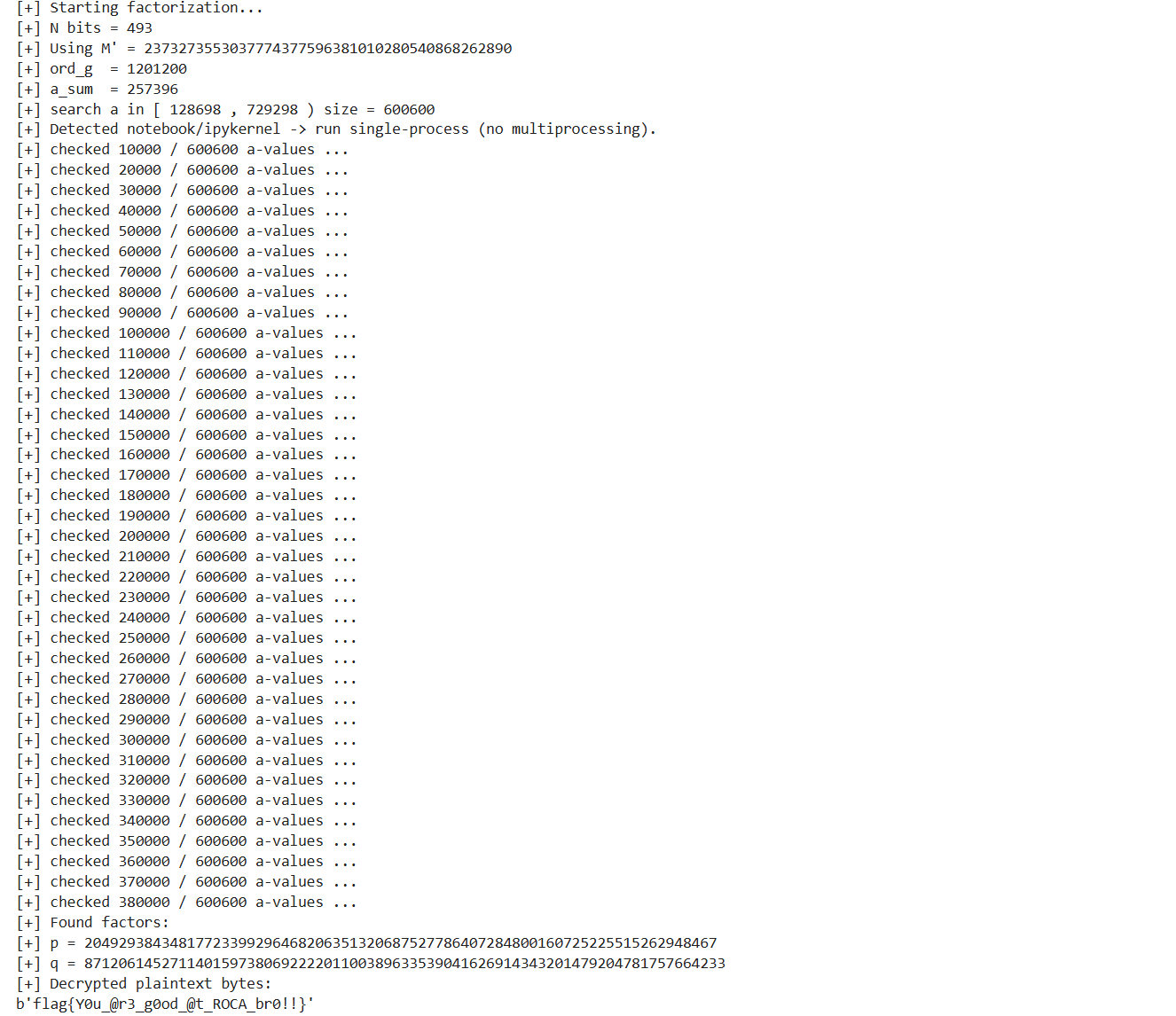
main()

运行结果:

复赛部分

题目1:rsa_final

一个rsa问题,给了u和v,分别是e模p-1和q-1的逆元,然后泄露了U=u mod 2^199和V=v mod 2^199,也就是u和v的低位
存在正整数 k1,k2k_1, k_2 满足:

eu=k1(p1)+1e \cdot u = k_1(p-1) + 1

ev=k2(q1)+1e \cdot v = k_2(q-1) + 1

由于 u<p1u < p-1,显然有 k1<ek_1 < e。题目限制了 ee 为 72 bit,因此 未知数 k1,k2k_1, k_2 被严格界定在 2722^{72} 的小范围内,可以打二元copper先解出k1和k2
将第一个等式变形,隔离出未知的素数 pp

k1p=eu1+k1k_1 \cdot p = e \cdot u - 1 + k_1

已知我们只掌握了低位 UU,可设高位部分为未知的 xux_u,即 u=U+xuQu = U + x_u \cdot Q。代入展开得到:

k1p=e(U+xuQ)1+k1=(eU1)+k1+xueQk_1 \cdot p = e(U + x_u \cdot Q) - 1 + k_1 = (e \cdot U - 1) + k_1 + x_u \cdot e \cdot Q

为了彻底消灭含有未知数 xux_u 的项,我们在等式两边同时对 M=eQM = e \cdot Q 取模。
令常量 A=eU1A = e \cdot U - 1B=eV1B = e \cdot V - 1,我们得到了纯净的模同余方程:

k1pA+k1(modM)k_1 \cdot p \equiv A + k_1 \pmod M

k2qB+k2(modM)(同理可得)k_2 \cdot q \equiv B + k_2 \pmod M \quad \text{(同理可得)}

将上述两个同余方程相乘,并代入已知量 n=pqn = p \cdot q

k1k2n(A+k1)(B+k2)(modM)k_1 \cdot k_2 \cdot n \equiv (A + k_1)(B + k_2) \pmod M

展开后,将 k1,k2k_1, k_2 视作代数变量 x,yx, y,得到标准的二元多项式同余方程:

(n1)xyBxAyAB0(modM)(n - 1)xy - Bx - Ay - AB \equiv 0 \pmod M

目标是求解该方程在 X,Y272X, Y \le 2^{72} 范围内的小根。然而,在实际构造格基规约时,有几个小问题:
1.非首一多项式
标准的 Coppersmith 往往要求 xyxy 的系数为 1。若强行除以公因数 g=gcd(n1,M)g = \gcd(n-1, M),由于剩余项 A,BA, B 不一定能被 gg 整除,会导致方程产生浮点数,破坏整数环特性。
因此,使用扩展欧几里得算法(XGCD)求出乘法逆元,提取真正的等价同余系数,将问题转化为非首一多项式的格基映射,并在格矩阵对角线填充 M2M^2

2.格维度问题
如果仅使用单次展开的 8x8 基础格(m=1m=1),理论求解上界为 XY<M0.3281XY < M^{0.3} \approx 2^{81}。但实际 XY=2144XY = 2^{144},根完全超出搜索范围。
引入多项式平方向(m=2m=2),构建 9x9 高维格,将上界提升至 XY<M0.552150XY < M^{0.55} \approx 2^{150},完美覆盖目标根。

在构造好 9x9 格矩阵并进行 LLL 规约后,算法会输出系数极小的代数独立多项式 h1(x,y)h_1(x,y)h2(x,y)h_2(x,y)
通过计算这两个多项式关于 yy结式(Resultant)(底层是通过计算西尔维斯特矩阵的行列式),可以彻底消去变量 yy,得到一个只含 xx 的一元多项式 R(x)=0R(x) = 0。求其整数根即可得到 k1k_1

求出 k1k_1 后,可以推导出 pp 的低位 p0p_0。但需注意,k1k_1 可能与 MM 存在公约数(如偶数),直接求逆元会触发 ZeroDivisionError。必须先通过 gcd(k1,M)\gcd(k_1, M) 进行约分。
由于 RSA 方程对称,利用已知的 k1k_1,可通过线性同余 Ck2D(modM)C \cdot k_2 \equiv D \pmod M 直接解出 k2k_2,进而求出 q0q_0

最后阶段利用 SageMath 的 small_roots 函数恢复完整的素数。
由于 p,qp, q 中必然一个大于 n\sqrt{n},一个小于 n\sqrt{n},而 beta=0.5 默认只能寻找大于 n\sqrt{n} 的因子。因此,必须分别将 p0p_0q0q_0 喂给 small_roots,并下调 epsilon=0.01 强制算法扩展搜索格维度,只要其中一个命中,即可抓出来

exp:

1
2
3
4
5
6
7
8
9
10
11
12
13
14
15
16
17
18
19
20
21
22
23
24
25
26
27
28
29
30
31
32
33
34
35
36
37
38
39
40
41
42
43
44
45
46
47
48
49
50
51
52
53
54
55
56
57
58
59
60
61
62
63
64
65
66
67
68
69
70
71
72
73
74
75
76
77
78
79
80
81
82
83
84
85
86
87
88
89
90
91
92
93
94
95
96
97
98
99
100
101
102
103
104
105
106
107
108
109
110
111
112
113
114
115
116
117
118
119
120
121
122
123
124
125
126
127
128
129
130
131
132
133
134
135
136
137
138
139
140
141
142
143
144
145
146
147
148
149
150
151
152
153
154
155
156
157
158
159
160
161
162
163
164
165
166
167
168
169
170
171
from Crypto.Util.number import long_to_bytes
import sys

# ================= 题目给定的已知参数 =================
e = 3269834770218481694809
n = 116751448703484355366840201775025865284279195145208042014752560554254636974525900445094434252393126306176328832097159472476466590293588331993005014071275598655101202121619626318044504094075467859952644155183869979160232841481376700194232735947985899320628279507496457026945044297152394600116703106832211346061
U = 555611581159257311716055656452890010637201822068729404411499
V = 520010580954705400377356820181443490009781402173307624774437
c = 99187346948849420907019215990061100332115122516855278156650894560306436495360198420769656203171806023514280892533005165646154539175562103367269192004403942772970427349736360945900801496540291398189377832235682243639988397146507656194107585761666153861534184005851946717219982375709146955987443467659229839064

# ================= 1. 数据预处理与非首一多项式构造 =================
Q = 2^199
M = e * Q
A_prime = e * U - 1
B_prime = e * V - 1

# 原始方程: C3*xy + C1*x + C2*y + C0 ≡ 0 (mod M)
C3 = (n - 1) % M
C1 = (-B_prime) % M
C2 = (-A_prime) % M
C0 = (-A_prime * B_prime) % M

# 使用 XGCD 将 C3 转换为真正的公约数 g,避免假性整除问题
g, u, v = xgcd(C3, M)

# 构建等价的新系数方程 F'(x,y) = g*xy + C1'*x + C2'*y + C0' ≡ 0 (mod M)
C1_prime = (u * C1) % M
C2_prime = (u * C2) % M
C0_prime = (u * C0) % M

# ================= 2. 构造严格映射的 9x9 格 =================
print("[+] Constructing mathematically sound 9x9 Lattice...")
X_bound = 2^72
Y_bound = 2^72

B_mat = Matrix(QQ, 9, 9)

# 对角线填充模数平方 M^2 (对应单项式 1, x, y, x^2, y^2)
for i in range(5):
B_mat[i, i] = M^2

# Row 5: M * F'(x,y)
B_mat[5, 0] = M * C0_prime; B_mat[5, 1] = M * C1_prime; B_mat[5, 2] = M * C2_prime; B_mat[5, 5] = M * g

# Row 6: x * M * F'(x,y)
B_mat[6, 1] = M * C0_prime; B_mat[6, 3] = M * C1_prime; B_mat[6, 5] = M * C2_prime; B_mat[6, 6] = M * g

# Row 7: y * M * F'(x,y)
B_mat[7, 2] = M * C0_prime; B_mat[7, 5] = M * C1_prime; B_mat[7, 4] = M * C2_prime; B_mat[7, 7] = M * g

# Row 8: F'(x,y)^2 (展开所有项)
B_mat[8, 0] = C0_prime^2
B_mat[8, 1] = 2 * C1_prime * C0_prime
B_mat[8, 2] = 2 * C2_prime * C0_prime
B_mat[8, 3] = C1_prime^2
B_mat[8, 4] = C2_prime^2
B_mat[8, 5] = 2 * g * C0_prime + 2 * C1_prime * C2_prime
B_mat[8, 6] = 2 * g * C1_prime
B_mat[8, 7] = 2 * g * C2_prime
B_mat[8, 8] = g^2

# 应用界限权重
W = [1, X_bound, Y_bound, X_bound^2, Y_bound^2, X_bound*Y_bound, (X_bound^2)*Y_bound, X_bound*(Y_bound^2), (X_bound^2)*(Y_bound^2)]

for i in range(9):
for j in range(9):
B_mat[i, j] *= W[j]

# ================= 3. LLL 规约与多项式结式求根 =================
print("[+] Running LLL reduction...")
B_mat = B_mat.LLL()

PR.<x,y> = PolynomialRing(ZZ)
monomials = [1, x, y, x^2, y^2, x*y, x^2*y, x*y^2, x^2*y^2]

def get_poly(row):
return sum(ZZ(B_mat[row, j] / W[j]) * monomials[j] for j in range(9))

polys = [get_poly(i) for i in range(9)]
k1_val = None

print("[+] Computing resultants to solve for x (k1)...")
for i in range(9):
for j in range(i + 1, 9):
res = polys[i].resultant(polys[j], y)
if not res.is_zero() and not res.is_constant():
pol_x = res.univariate_polynomial()
roots_x = pol_x.roots()
for root, mult in roots_x:
if root > 0 and root.is_integer():
k1_val = ZZ(root)
print(f"[+] Successfully found k1 = {k1_val}")
break
if k1_val: break
if k1_val: break

if not k1_val:
raise Exception("[-] ERROR: Mathematics failed to yield a root. Check matrix construction bounds.")

# ================= 4. 代数求 k2 与双重 Coppersmith 恢复 =================
print("[+] Recovering p0 using k1...")
# 消除 k1 与 M 可能存在的公约数
g_k1 = GCD(k1_val, M)
M_p = M // g_k1
p0 = (((A_prime + k1_val) // g_k1) * inverse_mod(k1_val // g_k1, M_p)) % M_p
print(f"[+] p0 = {p0}")

print("\n[+] Analytically extracting k2 using symmetry...")
C = (n - 1) * k1_val - A_prime
D = B_prime * k1_val + A_prime * B_prime
g_C = GCD(C, M)

k2_val = (ZZ(D // g_C) * inverse_mod(ZZ(C // g_C), ZZ(M // g_C))) % (M // g_C)
print(f"[+] Exact k2 found: {k2_val}")

print("[+] Recovering q0 using k2...")
# 【修复核心】:消除 k2 与 M 存在的公约数 (处理 ZeroDivisionError)
g_k2 = GCD(k2_val, M)
M_q = M // g_k2
q0 = (((B_prime + k2_val) // g_k2) * inverse_mod(k2_val // g_k2, M_q)) % M_q
print(f"[+] q0 = {q0}")

print("\n[+] Running Univariate Coppersmith (Dual Strike)...")
P.<k> = PolynomialRing(Zmod(n))

X_bound = 2^245
p = None

# 第一击:攻击 p
print(" -> Strike 1: Attacking p0...")
f_p = (p0 + k * M_p).monic()
roots_p = f_p.small_roots(X=X_bound, beta=0.499, epsilon=0.01)
if roots_p:
p = p0 + ZZ(roots_p[0]) * M_p
print(" [+] Hit! Success on p0.")

# 第二击:攻击 q
if not p:
print(" -> Missed p0. Strike 2: Attacking q0...")
# 注意这里要使用对应的 M_q
f_q = (q0 + k * M_q).monic()
roots_q = f_q.small_roots(X=X_bound, beta=0.499, epsilon=0.01)
if roots_q:
p = q0 + ZZ(roots_q[0]) * M_q
print(" [+] Hit! Success on q0.")

if p:
q = n // p
assert p * q == n
print(f"\n[+] Successfully factored n!")
print(f"p = {p}")
print(f"q = {q}")

# ================= 5. 解密密文 =================
phi = (p - 1) * (q - 1)
d = inverse_mod(e, phi)
m = pow(c, d, n)
# 使用 uuid 格式的 flag 提取
import re
flag_bytes = long_to_bytes(m)
print("\n[★] Raw Decrypted Bytes: ", flag_bytes)

try:
flag_str = flag_bytes.decode('utf-8', errors='ignore')
match = re.search(r'flag\{[a-f0-9\-]+\}', flag_str)
if match:
print("[★] Formatted Flag: ", match.group(0))
except Exception as e:
pass
else:
raise Exception("[-] Ultimate fail. Both strikes missed.")

flag:flag{ad9633bf-6300-450f-a21c-a2b72b6a6d86}