Crypto 方向

题目1:阶段1-AES的诞生

Step 1. 源代码审计
AES秘钥key的生成方式与时间戳有关
结合题目名字和多出来的附件,采用AES被官方发布的时间2001-11-26,然后换成Unix时间戳,得到key
Step 2. 读取data.txt,运行exp拿到flag
exp:

1
2
3
4
5
6
7
8
9
10
11
12
13
14
15
16
17
18
19
20
21
22
23
24
25
26
27
28
29
30
31
32
33
34
35
36
import re
from binascii import unhexlify
from cryptography.hazmat.primitives.ciphers import Cipher, algorithms, modes
from cryptography.hazmat.primitives import padding

# 1) 从 data.txt 读 iv 和密文
with open("data.txt", "r", encoding="utf-8") as f:
lines = f.read().splitlines()

iv_hex = lines[0].split("=")[1].strip()
cts = [re.search(r"\|\s*([0-9a-f]{32})\s*\|", ln).group(1) for ln in lines if ln.strip().startswith("|")]

iv = unhexlify(iv_hex)

# 2) “AES的诞生” => 2001-11-26 00:00:00 (UTC+8) => unix=1006704000
t = 1006704000 * 10**6
key = (str(t) * 2).encode() # 32 bytes

# 3) 解密每一块(注意:题目里每次都是用同一个 iv 重新 CBC,所以这里也每块独立解)
cipher = Cipher(algorithms.AES(key), modes.CBC(iv))

groups = []
for ct_hex in cts:
decryptor = cipher.decryptor()
pt_padded = decryptor.update(unhexlify(ct_hex)) + decryptor.finalize()

unpadder = padding.PKCS7(128).unpadder()
pt = unpadder.update(pt_padded) + unpadder.finalize()
groups.append(pt.decode())

# 4) 拼回二进制串:最后一组会混入随机字母数字,截到只剩 0/1
bin_str = "".join(groups[:-1]) + re.match(r"[01]+", groups[-1]).group(0)

flag_int = int(bin_str, 2)
flag_bytes = flag_int.to_bytes((flag_int.bit_length() + 7) // 8, "big")
print(flag_bytes.decode())

运行结果:

题目2:阶段1-Ez_RSA

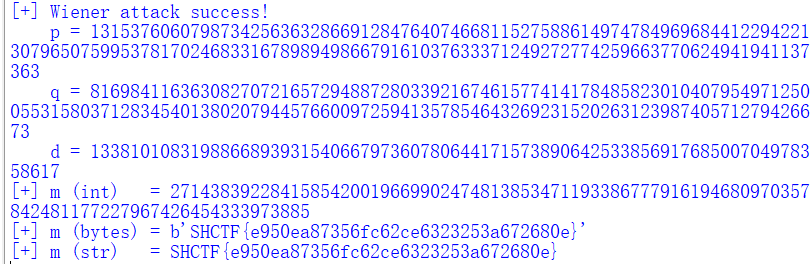
简单的维纳攻击

题目3:阶段1-Stream

Step 1. 源代码审计
流密码+LCG,一块明文和一块LCG生成的stream单独异或得到密文
由P_known和C_known先恢复LCG的基本参数,然后预测全部LCG状态,再解密C_flag得到flag

Step 2. exp

1
2
3
4
5
6
7
8
9
10
11
12
13
14
15
16
17
18
19
20
21
22
23
24
25
26
27
28
29
30
31
32
33
34
35
36
37
import math
from functools import reduce

P_known = b'Insecure_linear_congruential_random_number!!!!!!'
C_known = bytes.fromhex("44e18dfa1acd14aa790fc3bac4ca54c137bcd47bdfc2209a53b83715ecad3e29249845720588cac007bfb94f8476d91a")
C_flag = bytes.fromhex("1995374a5b64c6696578c1d5bdc6fa3d1e974b813436eab4348db801fb7a6703658eaa4fefa2c6fd6792beb969df8ca70ad87a4f4aea6ca0040d65a3c1e3a5bf2655cafc1e5603a171edc9aa077c0ca264677c351907f35756c14dd7ece428cb424a3804b544ccb53e99935f9bc2d8483dd7587379c99b3542c222008a")

def blocks8(b):
return [int.from_bytes(b[i:i+8], 'big') for i in range(0, len(b), 8)]

# 1) 恢复 x1..x6(keystream blocks)
P_blocks = blocks8(P_known)
C_blocks = blocks8(C_known)
x = [p ^ c for p, c in zip(P_blocks, C_blocks)] # x1..x6

# 2) 恢复 m:m | (t_{i+2}*t_i - t_{i+1}^2),取 gcd
t = [x[i+1] - x[i] for i in range(len(x)-1)]
u = [t[i+2]*t[i] - t[i+1]*t[i+1] for i in range(len(t)-2)]
m = reduce(math.gcd, [abs(ui) for ui in u])

# 3) 恢复 a,c
num = (x[2] - x[1]) % m
den = (x[1] - x[0]) % m
a = (num * pow(den, -1, m)) % m
c = (x[1] - a * x[0]) % m

# 4) 生成足够的 keystream 解密 C_flag
need_blocks = math.ceil(len(C_flag) / 8)
cur = x[-1]
ks = []
for _ in range(need_blocks):
cur = (a * cur + c) % m
ks.append(cur)

ks_bytes = b''.join(k.to_bytes(8, 'big') for k in ks)[:len(C_flag)]
flag = bytes(cb ^ kb for cb, kb in zip(C_flag, ks_bytes))
print(flag.decode(errors="replace"))

运行结果:

题目4:阶段1-TE

简单的共模攻击

题目5:阶段1-not_eight_length

费马分解得到的m:m=2659816110426110758853408064477848108780584180748829547395156778024725420435889565769424125
直接long_to_bytes后发现是乱码,结合题目,发现不是正常的8bit对齐,而是7-bit ASCII,且有少量padding
exp:

1
2
3
4
5
6
7
8
9
10
11
12
from Crypto.Util.number import long_to_bytes

m = 2659816110426110758853408064477848108780584180748829547395156778024725420435889565769424125

b = long_to_bytes(m)
bits = ''.join(f'{x:08b}' for x in b)

# 304 bits 不是 7 的倍数 -> 前面有 3 个 padding bit
bits = bits[3:]

flag = ''.join(chr(int(bits[i:i+7], 2)) for i in range(0, (len(bits)//7)*7, 7))
print(flag)

flag:SHCTF{99f4a238-9bd5-498a-b8ea-5cd243a36a19}

题目6:阶段1-古典也颇有韵味啊

秘钥找个培根密码的在线网址解密得到:NOTVIGENERE(其中 U/V 合并)
然后自钥维吉尼亚解密得到:oops!you made it! here is your flag:shctf{cl@ssic_c2ypto_also_crypt0}
修改flag头:SHCTF{cl@ssic_c2ypto_also_crypt0}

题目7:阶段2-Titanium Lock

Step 1. 源代码审计
总共有3个加密函数,我们一层一层剥开
先看f3:泄露的out可以回复出AES的key,每次操作选随机一个128位(与key一样位数)的n,然后做位与操作,输出模3,模2的结果
说得简单一点,也就是统计同一个比特位,key和n都是1的个数,然后取个数模3,模2的结果,那么我们可以发现余1的情况是确定的,所以取所有trace中余1的情况构建方程组,在GF(3)下可以解出key,也就可以破解f3的AES解密,得到f2的最终数据
再看f2:一个线性的变化,直接逆就行
相当于在方程y=C1*x+C2中,我们已知y,C1,C2,解出x即可
最后看f1:seed可以爆破,但是要注意坑点:last = ((int(c) + r) if int(c) % 2 == 0 else (int(c) * r)) ^ last
所以0和1的输出是一样的,难以分辨,那么就通过DFS和确定flag头SHCTF{},先确定高位,再爆破

Step 2. exp

1
2
3
4
5
6
7
8
9
10
11
12
13
14
15
16
17
18
19
20
21
22
23
24
25
26
27
28
29
30
31
32
33
34
35
36
37
38
39
40
41
42
43
44
45
46
47
48
49
50
51
52
53
54
55
56
57
58
59
60
61
62
63
64
65
66
67
68
69
70
71
72
73
74
75
76
77
78
79
80
81
82
83
84
85
86
87
88
89
90
91
92
93
94
95
96
97
98
99
100
101
102
103
104
105
106
107
108
109
110
111
112
113
114
115
116
117
118
119
120
121
122
123
124
125
126
127
128
129
130
131
132
133
134
135
136
137
138
139
140
141
142
143
144
145
146
147
148
149
150
151
152
153
154
155
156
157
158
159
160
161
162
163
164
165
166
167
168
169
170
171
172
173
174
175
176
177
178
179
180
181
182
183
184
185
186
187
188
189
190
191
192
193
194
195
196
197
198
199
200
201
202
203
204
205
206
207
208
209
210
211
212
213
214
215
216
217
218
219
220
221
222
223
224
225
226
227
228
229
230
231
232
233
234
235
236
237
238
239
240
241
242
243
244
245
246
247
248
249
250
251
252
253
254
255
256
257
258
259
260
261
262
263
264
265
266
267
268
269
270
271
272
import numpy as np
from hashlib import md5
from Crypto.Cipher import AES
from Crypto.Util.number import long_to_bytes
import random
import ast
import sys

# 增加整数转字符串的长度限制,防止超长数字报错
sys.set_int_max_str_digits(1000000)

def solve():
print("========================================")
print(" SHCTF Crypto Challenge Solver ")
print("========================================")

# ---------------------------------------------------
# 第一步:读取并解析数据
# ---------------------------------------------------
print("[-] Step 1: Loading data.txt...")
try:
with open("data.txt", "r") as f:
lines = f.readlines()
except FileNotFoundError:
print("[!] Error: data.txt not found.")
return

p1, p2, trace, result = None, None, None, None
for line in lines:
line = line.strip()
if not line: continue
if "=" in line:
k, v = line.split("=", 1)
k, v = k.strip(), v.strip()
# 使用 ast.literal_eval 安全解析列表,result 作为字符串直接读取
if k == "p1": p1 = ast.literal_eval(v)
elif k == "p2": p2 = ast.literal_eval(v)
elif k == "trace": trace = ast.literal_eval(v)
elif k == "result": result = v

if not (p1 and p2 and trace and result):
print("[!] Error: Failed to parse variables from data.txt")
return

# ---------------------------------------------------
# 第二步:利用侧信道泄露恢复 Key (GF(3) 高斯消元)
# ---------------------------------------------------
print("[-] Step 2: Recovering Key using Side-Channel Leakage...")
equations = []
targets = []

# 筛选出 output=1 的方程: popcount(n & k) % 3 == 1
for n, b in trace:
if b == 1:
bits = [(n >> i) & 1 for i in range(128)]
equations.append(bits)
targets.append(1)

# 取前 200 个方程构建矩阵
eq_count = min(len(equations), 200)
M = np.array(equations[:eq_count], dtype=int)
Y = np.array(targets[:eq_count], dtype=int)

# 高斯消元求解 Ax = b mod 3
rows, cols = M.shape
pivot_row = 0
aug = np.hstack((M, Y.reshape(-1, 1)))

for j in range(cols):
if pivot_row >= rows: break
candidates = np.where(aug[pivot_row:, j] % 3 != 0)[0]
if len(candidates) == 0: continue
curr = candidates[0] + pivot_row
aug[[pivot_row, curr]] = aug[[curr, pivot_row]]
inv = 1 if aug[pivot_row, j] % 3 == 1 else 2
aug[pivot_row] = (aug[pivot_row] * inv) % 3
for r in range(rows):
if r != pivot_row and aug[r, j] % 3 != 0:
factor = aug[r, j]
aug[r] = (aug[r] - factor * aug[pivot_row]) % 3
pivot_row += 1

key_val = 0
for j in range(cols):
for r in range(rows):
if aug[r, j] == 1 and np.sum(aug[r, :j]) == 0:
if aug[r, -1] == 1:
key_val |= (1 << j)
break

print(f" [+] Recovered Key: {key_val}")

# ---------------------------------------------------
# 第三步:解密 AES
# ---------------------------------------------------
print("[-] Step 3: Decrypting AES layer...")
try:
k_hash = md5(str(key_val).encode()).digest()
cipher = AES.new(k_hash, AES.MODE_CTR, nonce=b"Tiffany\x00")
decrypted_bytes = cipher.decrypt(bytes.fromhex(result))
data_list = ast.literal_eval(decrypted_bytes.decode())
print(f" [+] AES Decryption successful. Data length: {len(data_list)}")
except Exception as e:
print(f"[!] AES Error: {e}")
return

# ---------------------------------------------------
# 第四步:逆向 f2 (线性变换)
# ---------------------------------------------------
print("[-] Step 4: Reversing f2 (Matrix Inversion)...")
c1 = np.array(p1)
c2 = np.array(p2)
v_out = []

# 求解 C1 * x = y - C2
for i in range(0, len(data_list), 16):
y_chunk = np.array(data_list[i:i+16])
target = y_chunk - c2
x_sol, _, _, _ = np.linalg.lstsq(c1, target, rcond=None)
x_rounded = np.rint(x_sol).astype(int)
v_out.extend(x_rounded.tolist())

# 去除 Padding
# Padding 是 0-255 的随机数,有效数据通常远大于 100000
# 我们找到第一个小于 300 的数作为截断点
enc_data = []
for val in v_out:
if val > 300: # 阈值,区分 valid data 和 padding
enc_data.append(val)
else:
break

print(f" [+] Recovered encrypted data stream. Length: {len(enc_data)}")

# ---------------------------------------------------
# 第五步:逆向 f1 (Seed爆破 + DFS 歧义消除)
# ---------------------------------------------------
print("[-] Step 5: Cracking f1 (Brute-force Seed & DFS)...")

TARGET_PREFIX = b"SHCTF{" # 用于剪枝的已知前缀
correct_seed = None
digit_choices = []

# 1. 寻找正确的 Seed
# 遍历 100000 - 999999
for seed in range(100000, 1000000):
random.seed(seed)
last = 0
possible = True
current_choices_list = []

for val in enc_data:
target = val ^ last
last = val
r = random.randint(100000, 999999)

opts = []
# 偶数规则: d + r = target
for d in range(0, 10, 2):
if d + r == target: opts.append(d)
# 奇数规则: d * r = target
for d in range(1, 10, 2):
if d * r == target: opts.append(d)

if not opts:
possible = False
break
# 去重并排序
current_choices_list.append(sorted(list(set(opts))))

if possible:
correct_seed = seed
digit_choices = current_choices_list
print(f" [+] Found valid Seed: {seed}")
break

if correct_seed is None:
print("[!] Failed to find seed. Check padding logic.")
return

# 2. DFS 搜索解决 0/1 歧义
print(" [+] Starting DFS to resolve '0/1' collisions...")

ambiguous_count = sum(1 for opts in digit_choices if len(opts) > 1)
print(f" [i] Ambiguous positions found: {ambiguous_count}")

# DFS 函数
def check_solution(digits):
"""将数字列表转为 Flag 字符串并检查前缀"""
s = "".join(str(d) for d in digits)
try:
b = long_to_bytes(int(s))
# 检查前缀
if len(b) >= len(TARGET_PREFIX):
if not b.startswith(TARGET_PREFIX):
return False
# 检查完整性 (如果长度不够长,只要前缀对就可以继续)
# 但这里我们是在最后一步检查
return b
except:
return False

def dfs(idx, current_digits):
# 剪枝优化:每确定 2 位数字,就检查一次前缀
# 两位数字大约对应 6-7 bit,足够快速排除错误分支
if len(current_digits) > 10 and len(current_digits) % 2 == 0:
# 估算当前字节
s_partial = "".join(str(d) for d in current_digits)
# 补全后续为 0 以计算最小可能值
s_min = s_partial + "0" * (len(digit_choices) - len(current_digits))
s_max = s_partial + "9" * (len(digit_choices) - len(current_digits))
try:
b_min = long_to_bytes(int(s_min))
b_max = long_to_bytes(int(s_max))

# 获取已确定的公共前缀字节
common_len = 0
for i in range(min(len(b_min), len(b_max))):
if b_min[i] == b_max[i]:
common_len += 1
else:
break

stable_bytes = b_min[:common_len]

# 检查 Flag 头部
check_len = min(common_len, len(TARGET_PREFIX))
if stable_bytes[:check_len] != TARGET_PREFIX[:check_len]:
return None # 剪枝

# 检查可打印性 (除了头部)
for k in range(len(TARGET_PREFIX), common_len):
if not (32 <= stable_bytes[k] <= 126):
return None # 剪枝
except:
pass

# 终止条件
if idx == len(digit_choices):
s = "".join(str(d) for d in current_digits)
try:
final_bytes = long_to_bytes(int(s))
if final_bytes.startswith(TARGET_PREFIX) and final_bytes.endswith(b"}"):
return final_bytes
except:
pass
return None

# 递归搜索
for digit in digit_choices[idx]:
current_digits.append(digit)
res = dfs(idx + 1, current_digits)
if res: return res
current_digits.pop()

return None

# 执行搜索
# 为了避免递归深度过深(虽然这里只有几百层,Python默认1000,通常没问题),可以设置一下
sys.setrecursionlimit(5000)

flag = dfs(0, [])

if flag:
print("\n" + "="*40)
print(f" SUCCESS! Flag Found: \n {flag.decode()}")
print("="*40)
else:
print("\n[!] DFS finished but no flag found. Review constraints.")

if __name__ == "__main__":
solve()

运行结果:
![](/img/2026-SHCTF-crypto-Writeup/Titanium Lock/flag.png)

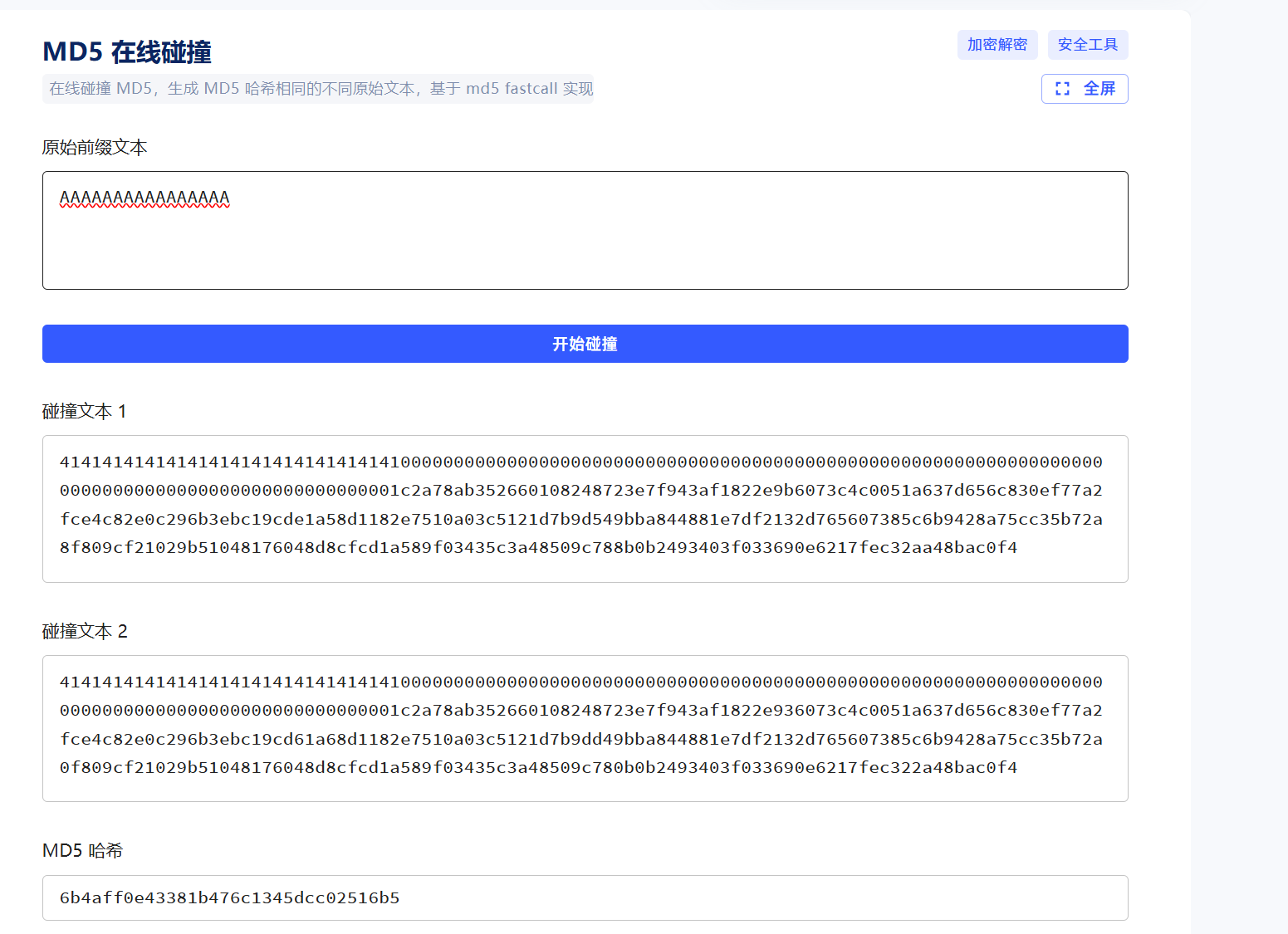
题目8-10:阶段2/3-hash 1 2 3

hash1 2 3是一个系列的,所以放在一起写
1只需要两串数据不同即可,2需要前16字节都是字母或者数字,在2的基础上加上前16字节必须不同
正常做法应该是用在线网站或者写脚本运行,但是鄙人偷了个懒,让Agent去已知的库里找一组出来,俗称站在巨人的肩膀上
1:Apple 1 (Hex): 4dc968ff0ee35c209572d4777b721587d36fa7b21bdc56b74a3dc0783e7b9518afbfa200a8284bf36e8e4b55b35f427593d849676da0d1555d8360fb5f07fea2
Apple 2 (Hex): 4dc968ff0ee35c209572d4777b721587d36fa7b21bdc56b74a3dc0783e7b9518afbfa202a8284bf36e8e4b55b35f427593d849676da0d1d55d8360fb5f07fea2
2:
3:Apple 1 (Hex): 69733161626369733161626369733161873339a7b1bdd071422a083b5f18b442d47365ee296aba07a2fd8ba1d5b5b43cf781f965218b61caa1fb197642f530ef760cf0db02f7ad2f3bbcd7f54e5c5aa214373a6831a94e2385fce4347642dceda16dcf1724037898cf42580b91d853db382270ee09bfd985a1792010d6ac4a5b
Apple 2 (Hex):
69733161626369733162626369733161873339a7b1bdd071422a083b5f18b442d47365ee296aba07a2fd8ba1d5b5b43cf781f965218b61caa1fb197642f530ef760cf0db02f7ad2f3bbbd7f54e5c5aa214373a6831a94e2385fce4347642dceda16dcf1724037898cf42580b91d853db382270ee09bfd985a1792010d6ac4a5b
然后输入终端分别得到flag,这里写wp的时候懒得去重新截屏flag了,不好意思(

题目11:阶段2-隐藏的子集和?

本人线代基础较差,现阶段暂时不能完全将设计到格问题的原理讲得非常明白,目前多依赖于Agent,未来会及时补上
这是一个经典的HSSP问题,目标是恢复原始矩阵A,但是有个巨大的干扰:x
所以得先消除x,也就是寻找正交空间,找到很多个向量u来构成矩阵A的补空间。
这些u首先满足在模p下与h正交:

uh0(modp)u \cdot h \equiv 0 \pmod p

代入:$$
u \cdot (xA) \equiv x \cdot (uA) \equiv 0 \pmod p

x很大,u和A都很小,也就是说u和A也大概率在模p下是正交的(不正交的概率为1/p) 然后再计算这些u的核空间,最后进行LLL找到包含flag的矩阵A的原始向量 这里有很多线代的专业知识,初次接触我也是一脸懵逼,慢慢补吧 exp:得用sage环境运行

1
2
3
4
5
6
7
8
9
10
11
12
13
14
15
16
17
18
19
20
21
22
23
24
25
26
27
28
29
30
31
32
33
34
35
36
37
38
39
40
41
42
43
44
45
46
47
48
49
50
51
52
53
54
55
56
57
58
59
60
61
62
63
64
65
66
67
68
69
70
71
72
73
74
75
76
77
78
79
80
81
82
83
84
85
86
87
88
89
90
91
92
93
94
95
96
97
98
99
100
101
import ast
from Crypto.Util.number import long_to_bytes

# 1. 读取数据
# 请确保 data.txt 在同一目录下
with open('data.txt', 'r') as f:
p = int(f.readline().strip())
h = ast.literal_eval(f.readline().strip())

# 过滤掉 h 中的方括号标记 (如果有的话,根据你提供的文件内容样例)
# 假设 h 是一个纯整数列表,如果 data.txt 格式复杂,请自行调整解析
# 这里假设 h 已经是一个 list of integers

n = 70
m = len(h)
print(f"[*] Parameters: n={n}, m={m}")
print(f"[*] Modulus p (approx {p.bit_length()} bits)")

# 2. 构建正交格 (Orthogonal Lattice)
# 我们寻找向量 u 使得 u * h = 0 mod p
# 构造格基矩阵 B (m x m):
# [ 1 0 ... -h_0 * h_{m-1}^-1 ]
# [ 0 1 ... -h_1 * h_{m-1}^-1 ]
# ...
# [ 0 0 ... p ]

# 确保 h 的最后一个元素可逆(p是质数,只要不为0即可)
# 如果 h[-1] 为 0,通常交换位置即可,但为了保持顺序对应,这里假设题目生成的随机数不为0
if h[-1] % p == 0:
raise ValueError("h[-1] is 0 mod p, need to swap specific columns.")

h_last_inv = inverse_mod(h[-1], p)

# 初始化单位阵
M = Matrix(ZZ, m, m)
for i in range(m - 1):
M[i, i] = 1
M[i, m - 1] = (-h[i] * h_last_inv) % p
M[m - 1, m - 1] = p

print("[*] Running LLL on orthogonal lattice (this may take a minute)...")
L = M.LLL()

# 3. 利用正交性恢复 A 的行空间
# 理论上,L 中的短向量 u 都满足 u * A^T = 0
# 我们取前 m-n 个最短的向量构成矩阵 U
# A 的行向量应该在 U 的右核 (Right Kernel) 中

print("[*] Computing kernel...")
# 取足够多的约束向量。理论上 rank(A) = n,所以我们需要 m-n 个正交约束
U = L[0 : m - n]
Kernel = U.right_kernel()

print("[*] Running LLL on Kernel basis to recover rows of A...")
# Kernel 的基包含了 A 的行向量。A 的行向量很短 (0,1,2),所以 LLL 应该能把它们找出来
Recovered_Basis = Kernel.basis_matrix().LLL()

# 4. 寻找 Flag
# flag 对应的行只包含 0 和 1 (或者全为 0 和 -1,因为基向量符号不确定)
print("[*] Searching for flag candidate...")

found = False
for row in Recovered_Basis:
vec = list(row)

# 检查是否只由 0, 1 组成
if all(x in [0, 1] for x in vec):
bits = "".join(str(x) for x in vec)
# 转为 bytes
try:
flag_int = int(bits, 2)
flag = long_to_bytes(flag_int)
if b'SHCTF{' in flag:
print(f"\n[SUCCESS] Flag found: {flag.decode()}")
found = True
break
except:
continue

# 检查是否只由 0, -1 组成 (LLL 可能会翻转符号)
elif all(x in [0, -1] for x in vec):
bits = "".join(str(-x) for x in vec)
try:
flag_int = int(bits, 2)
flag = long_to_bytes(flag_int)
if b'SHCTF{' in flag:
print(f"\n[SUCCESS] Flag found: {flag.decode()}")
found = True
break
except:
continue

if not found:
print("[-] Flag row not found immediately. Check the recovered basis manually or parameters.")
# 打印一些只有少量非0/1元素的行作为调试
for i, row in enumerate(Recovered_Basis):
vec = list(row)
# 简单统计非 0/1/-1 的元素个数
weird_counts = sum(1 for x in vec if x not in [0, 1, -1])
if weird_counts == 0:
print(f"Row {i} looks binary: {vec[:20]}...")

运行结果: ![](/img/2026-SHCTF-crypto-Writeup/隐藏的子集和?/flag.png) ### 题目12:阶段3-椭圆曲线 这题也蛮有意思的,两个漏洞,第一个利用start和end简单的线性关系直接得到secret 第二个是经典的ECDSA椭圆曲线数字签名中,两条消息共用一个k的情况,做个变化可以得出secret 懒得写脚本了,最后的flag是SHCTF{205436e5-d598-4859-a237-d3f40e7ed45b}